Blog
MemoFix Ingredients: How Does MemoFix Work and What Does Research Show?
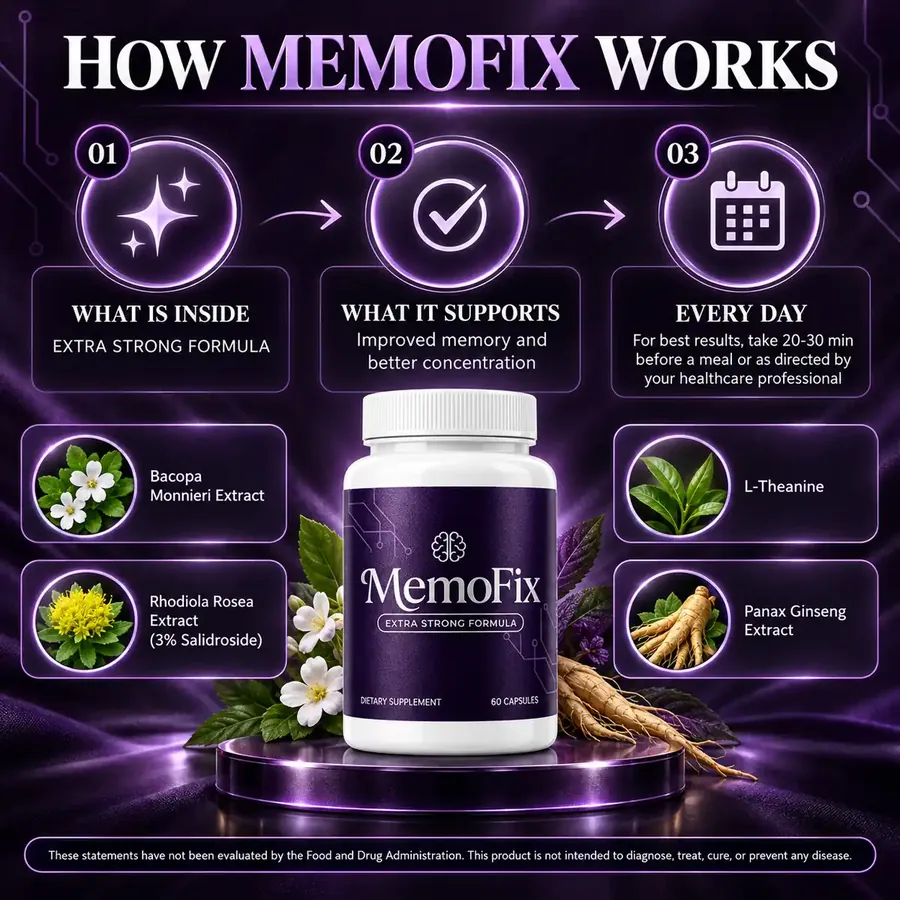
MemoFix ingredients are five actives per two-capsule serving: 540 mg of BCAAs, 200 mg of bacopa monnieri extract, 100 mg of rhodiola rosea extract (3% salidroside), 100 mg of L-theanine and 90 mg of Panax ginseng extract. No study of the finished capsule exists, so nobody can say exactly how MemoFix works. Research on each ingredient is mixed, and several label amounts sit below the doses studied.
At a glance
Key facts
- Five ingredients per 2 capsules: BCAAs 540 mg, bacopa 200 mg, rhodiola 100 mg, L-theanine 100 mg and ginseng 90 mg.
- The finished capsule has never been tested in a published trial, so its effect as a blend is unknown.
- The seller uses words such as "support" and "traditionally used." Those are marketing words, not findings.
- Bacopa memory trials ran 12 weeks at 300-450 mg a day. The label has 200 mg.
- BCAA muscle studies used 10-14 g. The label has 540 mg.
- The label dose is 2 capsules daily with an 8 oz. glass of water, 20-30 minutes before a meal.
- The product is not intended to diagnose, treat, cure, or prevent any disease.
The sales page version
What does the seller say about how MemoFix works?
The seller's story is short. It offers a handful of upbeat phrases and no mechanism.
The sales page lists four benefit lines: "Improved memory and better concentration," "Support for brain and cognitive health," "Carefully selected natural herbs for mental clarity" and "Long-term memory and cognitive well-being."
It also gives one line for each ingredient. The amino acids are "commonly featured for everyday energy and focus." Bacopa is "traditionally used to support memory retention and mental clarity." Rhodiola helps the body "feel balanced and resilient." L-theanine supports "calm, focused attention." Ginseng is "traditionally valued" for clarity and vitality.
Notice the verbs: featured, used, valued, included. None of them says "does." None of them gives a number, a trial or a source. That is normal for a sales page, but it means the page cannot answer the question in the title.
Ingredient by ingredient
What does research say about each MemoFix ingredient?
The table pairs each label amount with what trials of that single ingredient tested and found. None of these trials used MemoFix.
| Ingredient | On the label | Studied | What the research found |
|---|---|---|---|
| Bacopa extract | 200 mg | 300-450 mg a day for 12 weeks | Small speed-of-attention gains in 9 trials (Kongkeaw et al., 2014); better on 9 of 17 recall tests (Pase et al., 2012) |
| L-theanine | 100 mg | 200-400 mg a day | Lower stress scores at 200 mg a day for 4 weeks in 30 adults (Hidese et al., 2019) |
| Rhodiola extract | 100 mg | 100 to 680 mg a day | Results in fatigue trials were contradictory (Ishaque et al., 2012) |
| Panax ginseng extract | 90 mg | 100 to over 1,000 mg, by preparation | No convincing effect on thinking in healthy people (Geng et al., 2010 (Cochrane)) |
| BCAAs 2:1:1 | 540 mg | 10-14 g a day | Studied in muscle work, not memory (ODS, Exercise supplements) |
Read the right-hand column slowly. Only bacopa has a clear, small, memory-related result, and it took about three months. The other rows are weaker, mixed or about a different goal.
Label versus study
Does MemoFix contain the amounts that research used?
Mostly no. The herbs sit close to, but below, the studied amounts, and the amino acids are far below.
Lower doses are not automatically useless, and they may lower the chance of side effects. But results from a trial at one dose cannot be carried over to a smaller dose. The honest summary is that nobody knows what 200 mg of this bacopa does.
Extract strength adds to the doubt. The label states rhodiola as 3% salidroside. It does not print the bacoside level of the bacopa or the ginsenoside level of the ginseng. Two 200 mg bacopa extracts can differ a lot.
The missing study
Do the five ingredients work together as a blend?
That is the claim the seller implies, and it is the one least backed by data. We hold no trial that combined these five ingredients at these amounts.
A blend can behave like its parts. It can also do less than its parts, or something else. Without a study, all three outcomes remain open.
What a five-part formula may offer
- Several traditional herbs in one serving
- Every amount is printed, so you can compare it with studies
- A simple routine of 2 capsules a day
What a five-part formula cannot show
- That the parts add up to a memory benefit
- That the amounts match any trial
- That it works the same for every person
This is why we keep the language careful on this site. "May" and "is studied for" are fair words. "Works" and "boosts" are not, for a capsule with no trial of its own.
Reading the wording
What does the word support mean on a supplement label?
"Support" is a soft word on purpose. A supplement may describe how an ingredient affects the body's normal structure or function, but it may not claim to treat or prevent a disease.
The MemoFix label carries the standard statement that the product is not intended to diagnose, treat, cure, or prevent any disease. That statement is the legal frame around every upbeat phrase on the sales page (FDA, Supplement Q&A).
The FTC adds that claims of benefit should have reliable evidence behind them (FTC, Health claims). When you see "supports memory," ask what evidence stands behind it. For MemoFix, the answer is single-ingredient research, not a trial of the product.
The bigger levers
What shapes memory more than a capsule does?
Public health agencies list habits with stronger backing than any supplement. Regular physical activity, good sleep, managing stress and staying socially active are the common ones (NIA, Cognitive health).
The CDC lists risk factors that people can act on, such as blood pressure and physical inactivity (CDC, Dementia risk). A capsule does not replace any of that.
If you try MemoFix, keep these habits steady. Otherwise you cannot tell which change made a difference. A better week after a poor one can come from sleep, a lighter workload or a calmer month.
Know the limit
When should you ask a doctor instead of trying a supplement?
Forgetfulness that disrupts daily life needs a medical visit. Examples include repeating the same questions, getting lost in familiar places or trouble with bills (NIA, Memory problems).
Medicines, thyroid problems, low mood and poor sleep can all affect memory, and some of those causes can be treated. A supplement cannot sort them out for you.
Ask your doctor or pharmacist first if you take blood thinners, diabetes, blood pressure or mood medicines. Pregnant or nursing women, anyone under 18 and anyone with a known medical condition should talk to a physician before use. Ginseng may lower blood sugar, and rhodiola was reported to interact with losartan.
Where the facts come from
Which sources does this article use?
The bottle label, the seller brief and this site's own policy pages supply the product facts. The public sources below back the health and rules points. A fact none of them states appears here as "not published."
- Kongkeaw et al., 2014Meta-analysis of randomized controlled trials on cognitive effects of Bacopa monnieri extract. Kongkeaw C, et al. Journal of Ethnopharmacology, 2014.
- Pase et al., 2012The cognitive-enhancing effects of Bacopa monnieri: a systematic review of randomized, controlled human clinical trials. Pase MP, et al. Journal of Alternative and Complementary Medicine, 2012.
- Hidese et al., 2019Effects of L-Theanine Administration on Stress-Related Symptoms and Cognitive Functions in Healthy Adults: A Randomized Controlled Trial. Hidese S, et al. Nutrients, 2019.
- Ishaque et al., 2012Rhodiola rosea for physical and mental fatigue: a systematic review. Ishaque S, et al. BMC Complementary and Alternative Medicine, 2012.
- Geng et al., 2010 (Cochrane)Ginseng for cognition. Geng J, et al. Cochrane Database of Systematic Reviews, 2010.
- ODS, Exercise supplementsDietary Supplements for Exercise and Athletic Performance: Fact Sheet for Health Professionals. NIH Office of Dietary Supplements, 2026.
- FDA, Supplement Q&AQuestions and Answers on Dietary Supplements. U.S. Food and Drug Administration, 2026.
- FTC, Health claimsHealth Products Compliance Guidance. Federal Trade Commission, 2022.
- NIA, Cognitive healthCognitive Health and Older Adults. National Institute on Aging, 2024.
- CDC, Dementia riskReducing Risk for Dementia. Centers for Disease Control and Prevention, 2024.
- NIA, Memory problemsMemory Problems, Forgetfulness, and Aging. National Institute on Aging, 2023.
FAQ
Frequently asked questions
How does MemoFix work?
No one knows for the finished capsule, because no trial of MemoFix has been published. The seller names five ingredients, and research on each one is mixed.
Which MemoFix ingredient has the most memory research?
Bacopa. Trials ran 12 weeks at 300-450 mg a day, and the label has 200 mg. The gains seen were small.
Do the BCAAs in MemoFix build muscle?
Unlikely at this amount. The label has 540 mg, and studies in muscle work used 10-14 g a day.
Is the MemoFix dose the same as the studies?
No. Most label amounts sit below the amounts studied, and the bacopa and ginseng extract strengths are not published.
Is MemoFix a drug?
No. It is a dietary supplement. It is not FDA approved and is not intended to diagnose, treat, cure, or prevent any disease.
Can MemoFix replace advice from a doctor?
No. Memory problems that affect daily life need a doctor. Ask your doctor or pharmacist first if you take medicines.
Bottom line
Our view
The best honest answer to "how does it work?" is "we do not know." That sounds weak, but it is the only answer the evidence supports.
What we can say is smaller and more useful. The label lists five ingredients with amounts. One of them, bacopa, has a trail of modest trial results, and the label dose is below it. The rest of the formula rests on tradition and on research done for other goals.
If that still interests you, treat the first 60 days as a careful check with notes, keep your daily habits steady, and tell your doctor what you take.
MemoFix is a dietary supplement, not a drug. It is not FDA approved, and no supplement is. These statements have not been evaluated by the Food and Drug Administration. This product is not intended to diagnose, treat, cure, or prevent any disease.
USA Authorized Memofix Retailer
Look at the pack options and the 60-day terms, then read the label again before you decide.
We earn money when you buy through our order links. The price is set at checkout.
Last updated