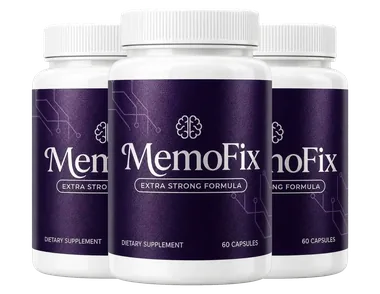
Formula
Memofix Ingredients: What Is in Each Serving
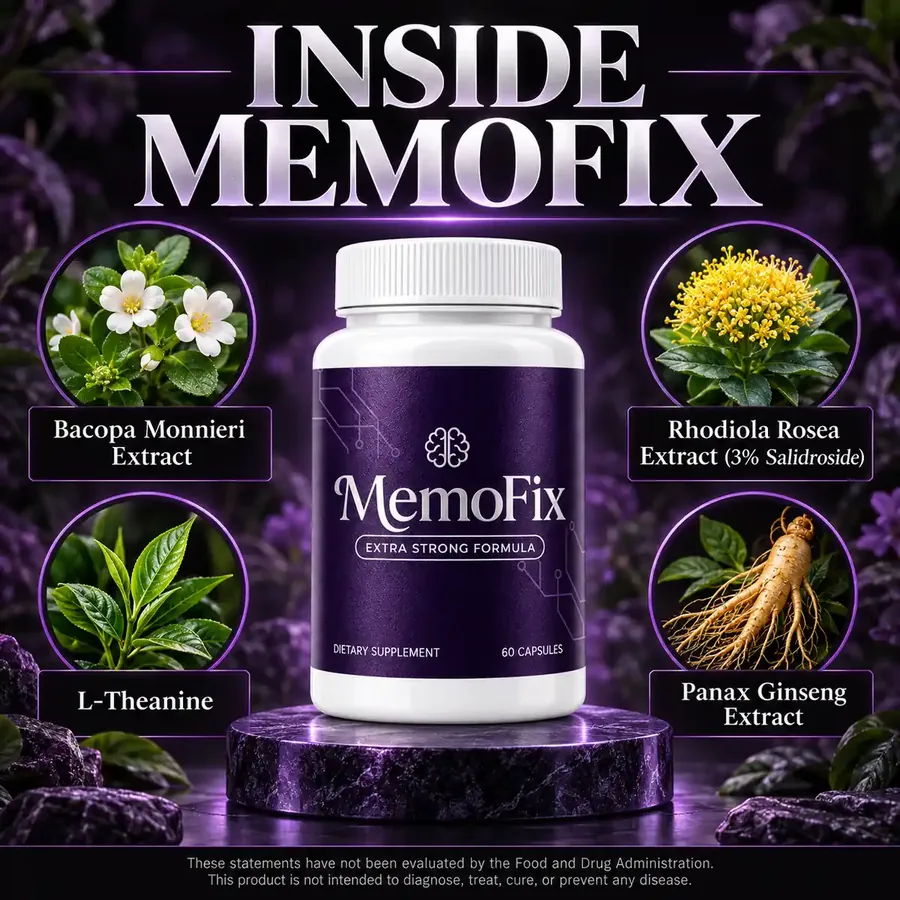
Each 2-capsule serving of Memofix lists five ingredients.
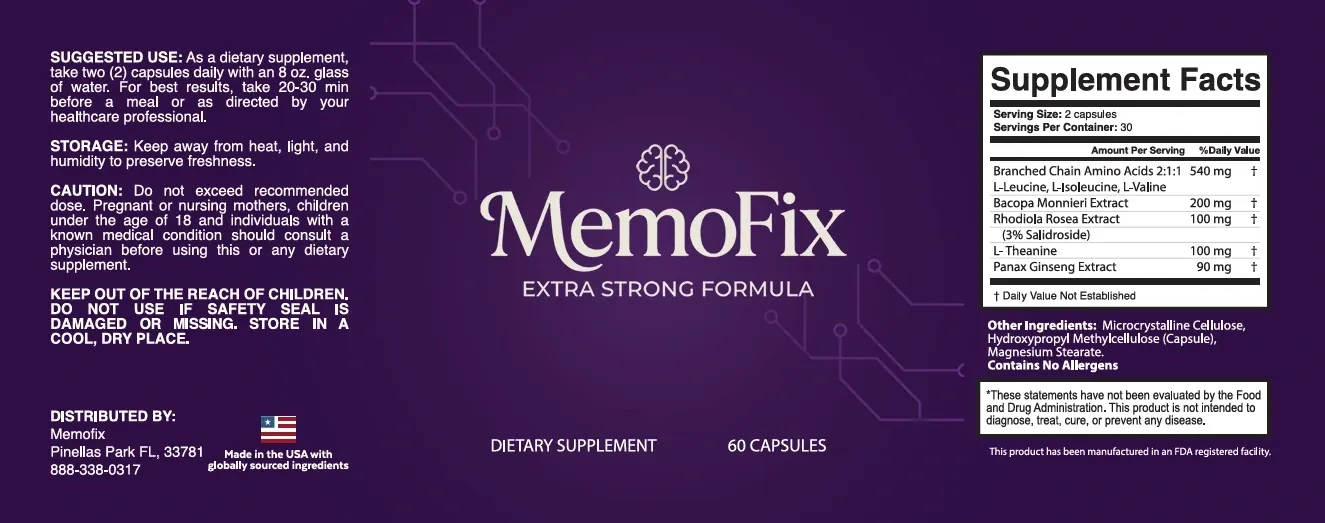
BCAAs 540 mg, bacopa extract 200 mg, rhodiola extract 100 mg (3% salidroside), L-theanine 100 mg and Panax ginseng extract 90 mg.
See the full Supplement Facts label.
The list
What ingredients are in Memofix?
Memofix contains three herbal extracts and two amino acid ingredients, 1,030 mg in all per serving.
Filter the list to split the herbs from the amino acids. Every amount matches the Supplement Facts panel on the bottle.
- 540mgBCAAs (leucine, isoleucine, valine)Branched Chain Amino Acids 2:1:1 (L-Leucine, L-Isoleucine, L-Valine)
- 200mgBacopa monnieriBacopa Monnieri Extract
- 100mgRhodiola roseaRhodiola Rosea Extract (3% Salidroside)
- 100mgL-theanineL-Theanine
- 90mgPanax (Asian) ginsengPanax Ginseng Extract
Amounts are per 2-capsule serving, exactly as printed on the Supplement Facts panel.
Doses
How do Memofix doses compare with research amounts?
Memofix sits closer to research doses than most memory formulas, but only for its herbs. The table sets each label amount beside what human studies gave.
| Ingredient | Per 2 capsules | Amount used in research |
|---|---|---|
| Branched Chain Amino Acids 2:1:1 (L-Leucine, L-Isoleucine, L-Valine) | 540 mg | 10-14 g a day in muscle studies (ODS, Exercise supplements) |
| Bacopa Monnieri Extract | 200 mg | 300-450 mg a day for 12 weeks in memory trials; typical 300-600 mg (Pase et al., 2012) |
| Rhodiola Rosea Extract (3% Salidroside) | 100 mg | 100-576 mg a day in mental-fatigue trials (Ishaque et al., 2012) |
| L-Theanine | 100 mg | 200 mg a day (4-week trial); 200-400 mg in stress studies (Williams et al., 2020) |
| Panax Ginseng Extract | 90 mg | 100 to over 1,000 mg a day, by preparation (LiverTox, Ginseng) |
Those studies tested single ingredients, mostly on attention, fatigue, stress or muscle. The full label transcription shows the lines these numbers come from.
Herb
Bacopa monnieri in Memofix: 200 mg of extract
Bacopa is a creeping wetland herb from Ayurvedic practice. It is the Memofix ingredient with the most memory research. Memofix gives 200 mg, about two thirds of the 300 mg that memory trials started from.
A 2012 review looked at six trials that gave 300 to 450 mg a day for 12 weeks. Bacopa beat placebo on 9 of 17 free-recall tests. The authors called the research young (Pase et al., 2012). A 2014 meta-analysis pooled 9 trials with 518 people. It found faster attention scores, by roughly 11 to 18 milliseconds on timed tasks (Kongkeaw et al., 2014).
- Typical daily intake in the literature: 300-600 mg of extract (LiverTox, Bacopa)
- Effects appeared after 12 weeks, not days
- Not shown to work for any disease in adequate trials (LiverTox, Bacopa)
The label does not print the bacoside percentage. So we cannot tell how closely this extract matches the ones tested. Our article on what bacopa research shows goes further.
Herb
Rhodiola rosea in Memofix: 100 mg at 3% salidroside
Rhodiola is a mountain plant sometimes called golden root. Memofix standardizes it to 3% salidroside. That works out to about 3 mg of salidroside per serving. The 100 mg total equals the lowest dose used in the mental-fatigue trials.
Mixed and unreplicated
Results were contradictory, and no independent team has repeated the positive trials (Hung et al., 2011).
Not enough reliable evidence
NCCIH says rhodiola has not been shown useful for any health purpose (NCCIH, Rhodiola).
NCCIH calls it possibly safe for up to 12 weeks. Reported effects include dizziness, dry mouth and trouble sleeping. An interaction with the blood pressure drug losartan has been reported (NCCIH, Rhodiola).
Amino acid
L-theanine in Memofix: 100 mg
L-theanine is an amino acid found in tea leaves. Memofix gives 100 mg. That is half the 200 mg used in the best-known trial.
In that trial, 30 healthy adults took 200 mg a day for four weeks. Their stress-related scores dropped. Verbal fluency and some planning tests improved (Hidese et al., 2019). A review of nine studies found that 200 to 400 mg a day may ease stress and anxiety. It also asked for longer and larger trials (Williams et al., 2020).
A cup of brewed tea carries some L-theanine. The amount varies a lot by leaf and brewing. There is no NIH fact sheet for L-theanine, so dose advice rests on the studies above.
Rhodiola and L-theanine are often sold together for stress. See rhodiola and L-theanine for stress.
Herb
Panax ginseng in Memofix: 90 mg of extract
Panax ginseng, also called Asian ginseng, is a root used in traditional Chinese medicine. Memofix lists 90 mg of extract. That is just under the 100 mg low end of common daily doses, which reach past 1,000 mg by preparation (LiverTox, Ginseng).
A Cochrane review of 9 trials found no convincing evidence that ginseng improves thinking in healthy people (Geng et al., 2010 (Cochrane)). NCCIH adds that it may help thinking in middle-aged adults but not young ones. Memory gains in some studies seemed to depend on added ginkgo (NCCIH, Asian ginseng).
Ginseng may lower blood sugar. Studies with warfarin are mixed, and interactions with some blood pressure drugs, statins and antidepressants are possible (NCCIH, Herb-drug interactions). It may be unsafe in pregnancy (NCCIH, Asian ginseng).
Like bacopa, the ginseng line gives no ginsenoside percentage. Read ginseng and your medicines before combining it with a prescription.
Amino acids
BCAAs in Memofix: 540 mg of leucine, isoleucine and valine
The branched chain amino acids are the largest line on the Memofix label. They total 540 mg in a 2:1:1 ratio. That ratio means roughly 270 mg of leucine and 135 mg each of isoleucine and valine.
BCAAs make up about a quarter of the amino acids in complete protein. Sports studies used 10 to 14 g a day and found inconsistent performance benefits (ODS, Exercise supplements). Memofix supplies about one twentieth of the low end.
Put another way, 540 mg of BCAAs is roughly what you get from about 2 grams of food protein. A couple of bites of chicken cover it. We found no research linking BCAAs to memory. This line adds weight to the serving more than evidence.
The rest of the capsule
What are the other ingredients in Memofix?
Besides the five active lines, Memofix lists three other ingredients. They form the capsule and help it fill evenly. The label prints "Contains No Allergens."
| Microcrystalline cellulose | A plant-fiber filler that bulks out the powder |
|---|---|
| Hydroxypropyl methylcellulose | The capsule shell, made from plant cellulose rather than gelatin |
| Magnesium stearate | A flow agent that keeps powder from sticking to machines |
| Caffeine or stimulants | None listed |
| Bacopa extract strength | Not published |
| Ginseng extract strength | Not published |
Balanced view
Where the Memofix formula is strong and where it falls short
The formula's best feature is honest numbers for real, studied herbs. Its weak points are an oversized BCAA line and two extracts with no stated strength.
Strong
- Every ingredient has a printed amount
- Rhodiola matches the lowest trial dose and is standardized
- Ginseng and bacopa sit within reach of study doses
- No stimulants and no listed allergens
Falls short
- BCAAs are half the weight but a tiny share of any studied dose
- L-theanine is half the trial amount
- Bacoside and ginsenoside levels not printed
- No trial of the combined formula
For what each ingredient is thought to do in the body, see how Memofix works. Side effects are covered on the safety page.
FAQ
Memofix ingredients FAQ
What is the main ingredient in Memofix?
By weight, the BCAAs at 540 mg. By research interest, bacopa at 200 mg, since it has the most memory studies.
Is the bacopa dose in Memofix high enough?
It is 200 mg, about two thirds of the 300 mg low end used in 12-week memory trials (Pase et al., 2012). The extract strength is not printed.
Does Memofix contain caffeine?
No. No caffeine or other stimulant appears on the label. L-theanine comes from tea but is not caffeine.
Is Memofix vegetarian?
The capsule shell is plant cellulose and no animal ingredient is listed. No certifier is named on the badge.
Why does Memofix include BCAAs?
The brand does not say. At 540 mg they are far below the 10-14 g used in muscle studies (ODS, Exercise supplements), and no memory research exists for them.
Does Memofix contain allergens?
The label says "Contains No Allergens." Check the other ingredients if you have a specific sensitivity.
Keep reading
More about Memofix
Supplement Facts
The whole Memofix label typed out, with notes on the extract strengths it does not print.
Read more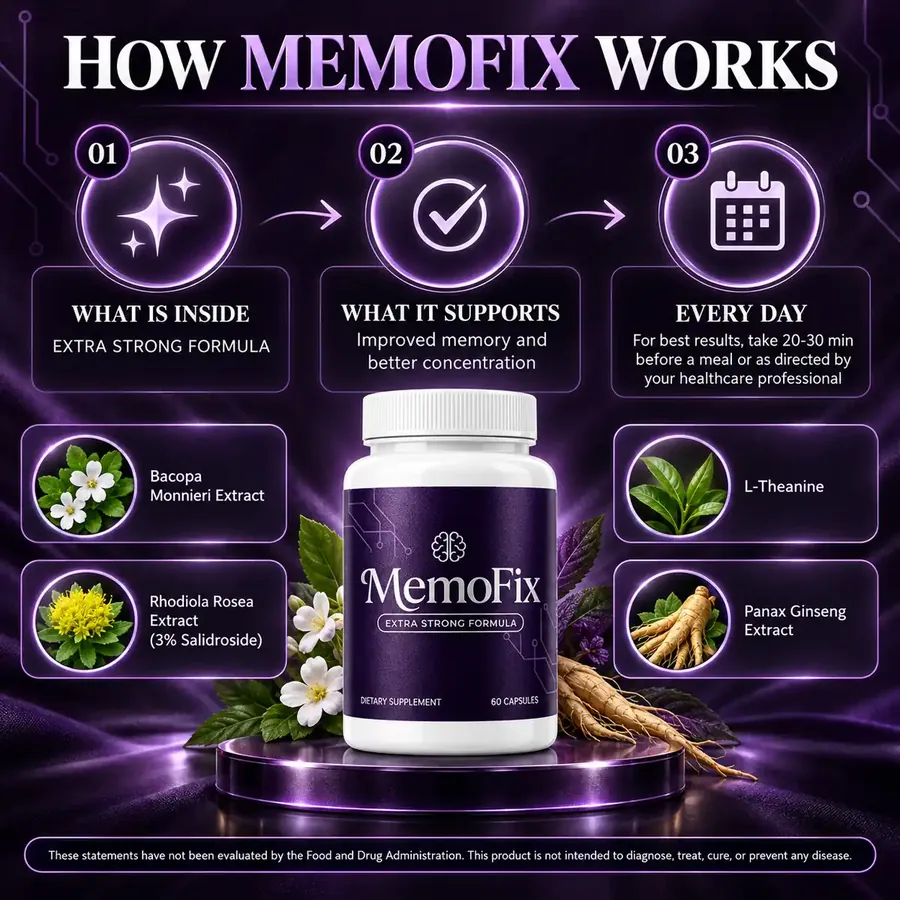
How it works
What each Memofix ingredient is thought to do in the body, in plain words, and where the evidence stops.
Read moreSide effects
Side effects reported for each Memofix ingredient, the medicine interactions to check, and the label cautions in full.
Read moreUSA Authorized Memofix Retailer
Ready to try Memofix with the 60-day guarantee?
Order through the authorized retailer's page so your order ID is on file with the refund desk. Two capsules a day; the 2-bottle pack covers the whole 60-day window.
Questions before you buy? Call +1 (302) 200-3480. 60-day money-back guarantee, return shipping paid by the buyer.