Blog
Is MemoFix FDA Approved? What an FDA Registered Facility Does and Does Not Mean
No. MemoFix is not FDA approved, and no dietary supplement is. The label says the capsules were made in an FDA registered facility. That line describes the factory, not the product inside. The FDA does not test supplements before they go on sale, so your checks are the label, the lot code and your doctor.
At a glance
Key facts
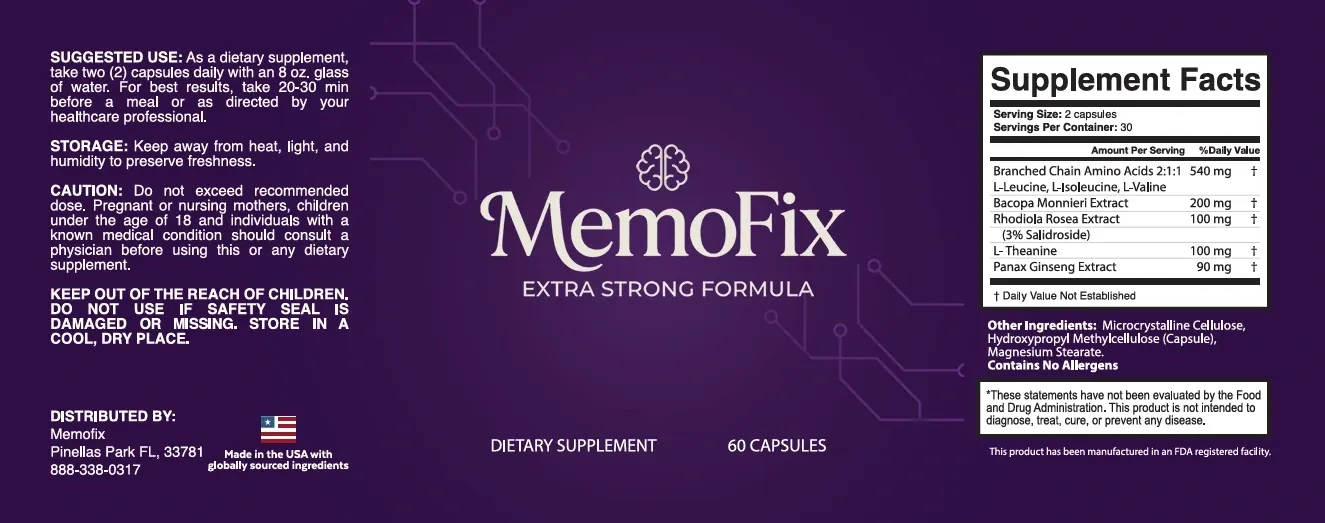
- MemoFix is a dietary supplement, not a drug. It is not FDA approved.
- The label says: "This product has been manufactured in an FDA registered facility."
- Registration is not approval. It tells the agency that a site exists and what it makes.
- The label also carries the standard FDA statement: not evaluated, and not intended to diagnose, treat, cure, or prevent any disease.
- The lot code MEM-26/GO-3537 and the CoA code MEM-3537-26-GO are references from the seller, not lab proof.
- A third-party lab report for MemoFix: not published. The name of the manufacturer: not published.
- The distributor printed on the label is Memofix, Pinellas Park, FL 33781.
The plain meaning
What does FDA approved actually mean?
Approval is something the FDA gives to a drug after it reviews the evidence. A dietary supplement does not go through that step.
The FDA itself explains that the phrase is easy to misuse. Its consumer page on the topic lists what the agency does and does not approve (FDA, Approval myths). Supplements sit on the "does not" side of that list.
So the honest question about any capsule in this category is not "is it approved?" The honest question is "what does the maker say, and what can I check?" The rest of this post uses that second question.
One more point on wording. A page that calls a supplement "FDA approved" is making a claim that cannot be true. A page that says "FDA registered" may be making a true claim that means far less than it sounds. Both deserve a slow read.
Four terms, four meanings
Is MemoFix FDA approved, FDA registered, or something else?
People mix these terms up all the time. The table keeps them apart and shows where MemoFix stands on each one.
| Term | What it means | Does it apply to MemoFix? |
|---|---|---|
| FDA approved | The agency reviewed evidence and cleared a drug | No. Supplements are not approved. |
| FDA registered facility | A site told the agency that it exists and what it makes | The label says the product was made in one. |
| FDA evaluated | The agency reviewed the statements on the label | No. The label says its statements were not evaluated. |
| GMP certified | A named body audited the site against manufacturing rules | A brand badge shows GMP, but no certifier is named. |
The first row is the one that trips people up. A seller can say true things on each of the other rows and still leave a reader thinking the first row is yes. MemoFix does not claim approval on its label, which keeps the label honest.
The rules in short
What does the FDA check on supplements before sale?
The FDA does not check supplements for safety or effect before they reach shelves. The maker is responsible for the product and for the evidence behind its claims (FDA, Supplement Q&A).
A second agency also matters here. The FTC publishes guidance saying that health claims should rest on reliable evidence (FTC, Health claims). It once won a case over a memory supplement whose claims it said were not backed up (FTC, Prevagen ruling).
That case is not about MemoFix, and we do not suggest it is. We mention it because it shows why a calm look at claims is worth your time. Memory is a topic where bold wording is common.
For MemoFix, the sales page claims include "Improved memory and better concentration" and "Support for brain and cognitive health." No trial of MemoFix itself backs those lines. The research we cite covers single ingredients, not the finished capsule.
A quick filter
How can you spot a false FDA approved claim?
Run any supplement page through these checks. They take two minutes.
- Search the page for the words "approved by the FDA." If you find them next to a supplement, the claim is wrong.
- Look for the standard disclaimer saying the statements were not evaluated. A real label has it.
- Check whether "registered" is used as if it meant "approved." It does not.
- Look for badges with no named certifier. A badge without a name is the seller's own statement.
- Notice words such as "safe" and "fast results." They are marketing, not a regulator's finding.
- Compare the page with the label. If the page says more than the label, trust the label.
MemoFix passes the first check on its label. Its sales material uses upbeat words, so the last two checks still apply.
What is on the table
What proof of quality does MemoFix offer besides the FDA line?
The strongest point is openness about amounts. Every ingredient has its own printed amount, and nothing hides inside a blend total. The gaps are listed next to the strengths below.
| Item | What is published |
|---|---|
| Where made | Made in the USA with globally sourced ingredients (label) |
| Facility | FDA registered facility (label); registration is not approval |
| Ingredient amounts | All five printed: 540, 200, 100, 100 and 90 mg per 2 capsules |
| Rhodiola strength | 3% salidroside (label) |
| Bacopa and ginseng strength | Not published |
| Allergen line | Contains No Allergens (label) |
| Third-party lab report | Not published |
| Lot and CoA codes | Seller reference codes, not lab proof |
A code is a filing number. It becomes proof only when a named lab's signed report sits behind it. Until that report is shared, treat the codes as a way to trace an order and nothing more.
Your questions
What can you ask the order desk to fill the gaps?
You are allowed to ask. A seller that stands behind a batch should be able to answer plain questions, and the answers help you decide.
Ask for the report
Request a certificate from a named lab, matched to the lot code printed on your bottle.
Ask for strengths
Ask for the bacoside level of the bacopa and the ginsenoside level of the ginseng.
Ask who made it
The label names only the distributor. Ask for the name of the manufacturer.
Ask about the badges
Ask which body, if any, issued the GMP and other badges.
Write down the reply
Note the date, the time and the name of the person you spoke to.
Use the order desk line, +1 (302) 200-3480, for these questions. The website inbox, [email protected], has no view of orders or batches.
Putting it to use
Where does FDA information fit into your own safety plan?
Use the FDA pages as background, and use your doctor as the real check. The agency's rules explain why the label matters. They cannot tell you whether MemoFix suits you.
Start with the label caution. Pregnant or nursing mothers, children under 18 and anyone with a known medical condition should talk to a physician first. Then bring the full bottle to a pharmacist if you take any medicine.
Ask your doctor or pharmacist first if you take blood thinners, diabetes, blood pressure or mood medicines. Pregnant or nursing women, anyone under 18 and anyone with a known medical condition should talk to a physician before use. Ginseng may lower blood sugar, and rhodiola was reported to interact with losartan.
If you feel unwell after taking any supplement, stop and call a doctor. Serious reactions can also be reported to the FDA through its MedWatch program. That report helps the agency spot patterns, which no single seller can do.
Where the facts come from
Which sources does this article use?
The bottle label, the seller brief and this site's own policy pages supply the product facts. The public sources below back the health and rules points. A fact none of them states appears here as "not published."
- FDA, Approval mythsIs It Really 'FDA Approved'?. U.S. Food and Drug Administration, 2026.
- FDA, Supplement Q&AQuestions and Answers on Dietary Supplements. U.S. Food and Drug Administration, 2026.
- FTC, Health claimsHealth Products Compliance Guidance. Federal Trade Commission, 2022.
- FTC, Prevagen rulingStatement on FTC's Win in Lawsuit Against the Makers of Dietary Supplement Prevagen. Federal Trade Commission, 2024.
- FDA, Labeling guideDietary Supplement Labeling Guide: Chapter IV. Nutrition Labeling. U.S. Food and Drug Administration, 2005.
FAQ
Frequently asked questions
Is MemoFix FDA approved?
No. The FDA does not approve dietary supplements, and MemoFix does not claim approval. The label says it was made in an FDA registered facility.
What does FDA registered facility mean on the MemoFix label?
It means the site where the capsules were made is registered with the FDA. It is not a review of MemoFix and not a seal of approval.
Is MemoFix GMP certified?
A Good Manufacturing Practice badge appears in the brand material, but no certifier or audit report is named. We cannot confirm GMP certification.
Has the FDA tested MemoFix?
The label says its statements have not been evaluated by the FDA. The FDA does not test supplements before sale.
Does MemoFix have a third-party lab report?
No report has been shared with us. The lot and CoA codes come from the seller, so ask the order desk for a report tied to your lot.
Who manufactures MemoFix?
The manufacturer's name is not published. The distributor printed on the label is Memofix of Pinellas Park, Florida.
Bottom line
Our view
The short answer is no, and we think a clear no is better than a vague yes. MemoFix is a supplement, and no supplement carries FDA approval.
What helps more is how open the label is. The amounts are printed, the facility claim is worded carefully, and the standard disclaimer is there. What is missing is an outside lab report, so we would ask for one before we leaned on any quality claim.
Use the 60-day money-back window as a safety net, speak to your doctor if you take medicines, and read every badge as the seller's own words until a certifier is named.
MemoFix is a dietary supplement, not a drug. It is not FDA approved, and no supplement is. These statements have not been evaluated by the Food and Drug Administration. This product is not intended to diagnose, treat, cure, or prevent any disease.
USA Authorized Memofix Retailer
Read the pack options and the 60-day terms on the order page, then decide with the label in hand.
We earn money when you buy through our order links. The price is set at checkout.
Last updated